The Howard Johnson Anaheim Hotel and Water Playground has launched a sweeping $30 million transformation that will reshape 302 rooms, public spaces, and amenities over the next year—while the property remains fully operational. For Orange County, CA hotels navigating similar upgrade cycles, this project offers both a roadmap and a warning: renovation timelines in 2027 will hinge not on construction speed alone, but on how quickly owners can coordinate furniture liquidation, FF&E procurement, mattress replacement, recycling, and final installation. With construction scheduled for completion in June 2027, the Howard Johnson case study reveals why Southern California properties competing for the same contractors, installers, and trucking capacity must plan every phase backward from their reopening date—or risk carrying construction disruption into another busy season.
Inside the Howard Johnson Anaheim $30M Renovation: Scope, Timeline, and Orange County, CA Hotels Market Context
R.D. Olson Construction broke ground in July 2026 on the third phase of upgrades at the seven-acre Howard Johnson Anaheim, located at 1380 S Harbor Boulevard directly across from the Disneyland Resort. Lee & Sakahara Architects Inc. is leading the design effort, which aims to preserve the mid-century resort aesthetic originally created by architect William Pereira when the property opened in 1965. The project, branded “HoJo Anaheim Reimagined,” will refurbish four buildings containing 93 rooms with a polychromatic makeover inspired by the property’s midcentury roots, while converting 18 standard rooms into 10 larger one-bedroom suites—reducing the total room count from 302 to 293.
This marks the third round of upgrades R.D. Olson has completed for the hotel in the last eight years, underscoring the accelerating pace of renovation cycles across Southern California’s hospitality market. The scope extends beyond guest rooms: R.D. Olson is demolishing and rebuilding the hotel’s courtyard to add greener landscapes, a new fountain, and an upgraded swing area at the resort’s Castaway Cove Water Playground. Four new bridges and walkways will be constructed to provide easier access across the property, along with translucent panels, multi-colored concrete, and terrazzo-style finishes throughout. A new elevator will serve the four renovated buildings, and approximately 231 square feet of lobby space will be remodeled to update an existing breakroom and storage area, while a 1,027-square-foot game room converts into an accounting office.
For Orange County, CA hotels, this activity reflects a broader wave of repositioning projects. Properties competing for the same FF&E vendors, installation crews, and disposal resources during peak renovation periods may face longer lead times, especially as multiple hotels target mid-2027 completion dates. The Howard Johnson timeline—July 2026 start, June 2027 finish—leaves little margin for delays in furniture removal, procurement, or installation. When a property remains open throughout construction, every day of delay in one phase pushes back room turnover and revenue recovery.
Why Orange County, CA Hotels Are Under Pressure in 2027
Southern California’s hotel market is moving through a new wave of room upgrades, public-space improvements, and repositioning projects. For owners and general managers, that development matters because a renovation schedule is rarely controlled by construction alone. Furniture liquidation, FF&E procurement, mattress replacement, recycling, delivery, and final installation can determine whether a property reopens on time—or carries construction disruption into another busy season. The Howard Johnson project illustrates this reality: refurbishing 93 rooms while maintaining full operations requires precise coordination between demolition crews, furniture removal teams, contractors, and installers. A single bottleneck in mattress disposal or case goods delivery can cascade through the schedule, delaying room inspections, punch-list completion, and final turnover to housekeeping.
The Hidden Renovation Timeline: Why FF&E Coordination Determines Your 2027 Reopening Date
The most reliable renovation timelines are built backward from the reopening date. Instead of asking when furniture can be installed, project teams should identify every preceding milestone: final design approval, purchasing, shipping, room release, demolition, disposal, staging, installation, inspection, and punch-list completion. Each stage depends on the one before it, and delays compound quickly.
A new bed package cannot be installed efficiently if old mattresses remain in the rooms. New case goods cannot be placed safely if demolition debris blocks corridors. Likewise, furniture removal must often happen in a precise sequence so that rooms can be released to contractors, inspected, cleaned, and returned to inventory. For Orange County, CA hotels targeting a mid-2027 reopening, this means furniture liquidation and FF&E planning should already be underway—not scheduled for the week before installation.
The Six-Stage Renovation Workflow That Prevents Timeline Crunch
Successful renovations follow a coordinated workflow that treats furniture liquidation, recycling, and installation as integrated phases rather than isolated contracts:
- Pre-renovation assessment: Identify the furniture, mattresses, fixtures, and equipment that will be removed, retained, recycled, or resold. Document quantities, condition, and access requirements for every room type and common area.
- Detailed scope and pricing: Confirm quantities, access requirements, room counts, labor needs, disposal arrangements, and target dates. Per-item pricing eliminates surprises and allows accurate budgeting.
- Room release: Coordinate with ownership, management, housekeeping, construction, and engineering so spaces become available in the correct order. Stagger releases to maintain revenue while construction progresses.
- Removal and protection: Use organized crews to remove furnishings while protecting floors, walls, doors, elevators, and corridors. Damage during removal can add days to the schedule and thousands to the budget.
- Installation: Deliver and install beds, case goods, seating, lighting, artwork, televisions, headboards, and other FF&E components according to project specifications. Secure mounting prevents accidental damage and theft.
- Inspection and turnover: Check room condition, installation quality, mounting security, missing items, and punch-list requirements before reopening. Final inspections should happen with housekeeping and engineering present to catch issues before guests arrive.
This workflow matters because each stage has a lead time. Mattress recycling partners need advance notice to schedule pickup. FF&E vendors require weeks or months to manufacture and ship custom pieces. Installation crews must be booked in advance, especially during peak renovation season. Properties that wait until construction is nearly complete to address furniture removal and installation often discover that their preferred vendors are booked weeks out, forcing them to either delay reopening or accept substandard service.
Mattress Recycling and Environmental Compliance: Why California Hotels Can’t Skip This Step
Recycling can affect both the schedule and the project’s environmental profile. California’s mattress recycling regulations create compliance obligations that out-of-state owners sometimes overlook. The state operates a mattress stewardship program that requires retailers and renovators to participate in recycling efforts, and hotels replacing large quantities of mattresses must document proper disposal.
Partnerships with certified recyclers like MBC Mattress Recycling and Gateway Mattress Recycling give mattresses and furniture a second life, reducing landfill waste and providing repurposed items for resale to independent hotels and motels. Planning recycling before demolition begins prevents unwanted mattresses and furnishings from accumulating in service areas, where they create safety hazards and delay construction access. It also gives the project team a documented path for materials that should not be sent directly to landfill.
Hotels purchasing repurposed furnishings may additionally qualify for green certificate programs, creating a potential marketing benefit for properties emphasizing environmental responsibility. For Orange County, CA hotels targeting eco-conscious travelers, documented recycling and reuse can become part of the property’s sustainability story—but only if the recycling process is planned into the timeline from the start, not treated as an afterthought when old mattresses pile up in loading docks.
How Recycling Delays Impact Room Turnover
When mattress removal is delayed, rooms cannot be released to contractors for flooring, painting, or fixture installation. When recycling pickups are not coordinated with demolition schedules, old mattresses block corridors and elevators, slowing down other trades. When disposal documentation is incomplete, properties risk compliance issues that can halt work entirely. The solution is to integrate recycling into the removal phase, with scheduled pickups that align with room release dates and contractor access needs.
Anaheim Hotel FF&E Coordination 2027: Local Resources and Timeline Advantages
The practical value of working with a local hospitality specialist in Anaheim is coordination. A provider based in Orange County can help owners connect furniture liquidation, mattress services, recycling, FF&E installation, and timeline management rather than treating each task as an isolated contract. This matters because renovation schedules are connected: a delay in furniture removal pushes back demolition, which delays construction, which delays installation, which delays inspection, which delays reopening.
For the Howard Johnson Anaheim project, maintaining full operations while renovating 93 rooms requires meticulous scheduling. Guests cannot be displaced for extended periods, so rooms must move through the renovation cycle quickly. That means furniture removal, demolition, construction, and installation must happen in tight succession, with minimal gaps between phases. A local provider can respond quickly to schedule changes, deliver on short notice, and coordinate with on-site teams in real time—advantages that become critical when a property is trying to turn rooms over in days rather than weeks.
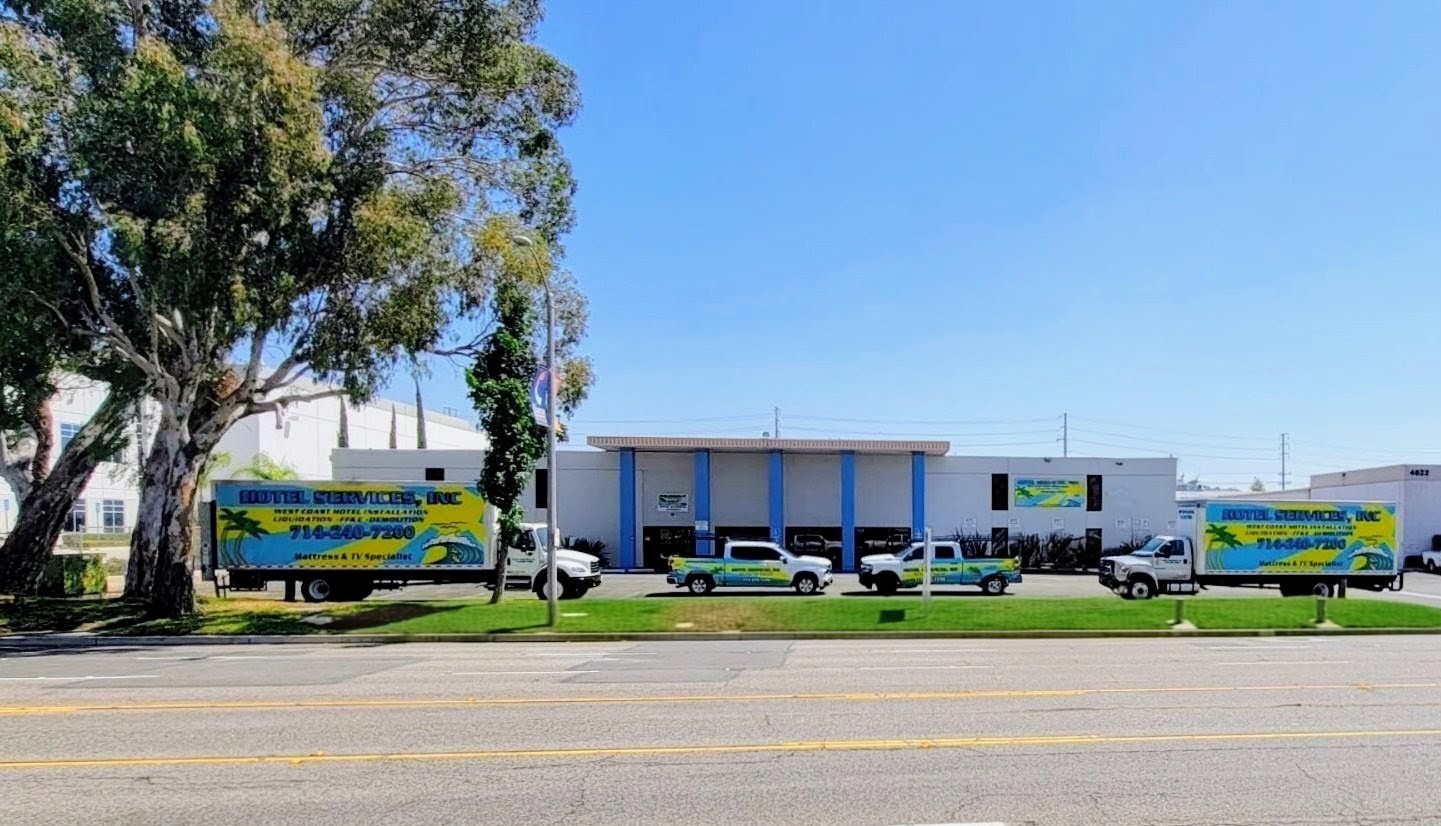
Hotel Services Inc., based at 4640 E La Palma Ave in Anaheim at the crossroads of E. La Palma and Lakeview near the 91 and 55 freeways, offers this integrated approach. The company handles liquidation, recycling, FF&E coordination, mattress removal and installation, and nationwide installation through one coordinated workflow. Its liquidation crews remove unwanted furniture and décor from guest rooms and common areas, while its installation teams handle replacement furnishings according to project specifications. The company also partners with MBC Mattress Recycling and Gateway Mattress Recycling to provide documented recycling services.
Why Orange County, CA Hotels Renovation Timeline Planning Starts Now
Properties targeting a 2027 reopening should already be in the planning phase. Design decisions, FF&E procurement, vendor selection, and scheduling must happen months before the first piece of furniture is removed. For Orange County, CA hotels competing for the same contractors and installers as the Howard Johnson Anaheim and other nearby properties, early planning secures preferred vendors and avoids the timeline crunch that occurs when multiple hotels try to book the same resources during peak season.
The Howard Johnson case study shows what’s possible when planning is thorough: a $30 million renovation completed in under a year, with the property remaining fully operational throughout. But that outcome depends on every vendor—construction, demolition, furniture removal, recycling, FF&E installation—executing on schedule. A single delay in furniture liquidation can push back room release, which delays construction, which delays installation, which delays reopening. For properties that haven’t yet started planning their 2027 renovations, the window is closing.
Conclusion: How to Avoid the 2027 FF&E Timeline Crunch in Orange County, CA Hotels
The Howard Johnson Anaheim’s $30 million renovation demonstrates that ambitious timelines are achievable when every phase of the project is coordinated. But it also reveals the risks: properties that treat furniture liquidation, recycling, and FF&E installation as afterthoughts will face delays, cost overruns, and extended disruptions. For Orange County, CA hotels planning renovations in 2027, the lesson is clear—start planning now, build your timeline backward from the reopening date, and work with providers who can integrate multiple services into one coordinated workflow.
Hotel Services Inc. offers free on-site assessments for Southern California properties and remote solutions for out-of-state clients. With per-item pricing, detailed cost breakdowns, and a 100% guarantee on all work, the company provides the coordination and reliability that renovation timelines demand. Whether you’re refurbishing 93 rooms like the Howard Johnson or planning a complete property transformation, early planning and integrated vendor coordination will determine whether you reopen on schedule—or carry construction disruption into another busy season.
For bid estimates and project consultations, contact John at (949) 310-2277 or (714) 240-7200. General inquiries: (714) 541-7600 or 888-238-5252. Visit the Anaheim showroom at 4640 E La Palma Ave or explore inventory online at hotelserviceinc.com.