Southern California’s hotel renovation cycle is accelerating into 2026, and the stakes have never been higher. Owners are facing compressed timelines, rising tariffs on imported FF&E, and a construction market stretched thin by competing projects. In this environment, the difference between a property that reopens on schedule and one that bleeds revenue into another quarter often comes down to a single factor: logistics. Specifically, how quickly furniture, fixtures, and equipment move from warehouse to guest room—and how well those moves are coordinated with contractors, inspectors, and opening-day deadlines. This article explores why local logistics infrastructure in Southern California matters more than ever, how recent market developments are reshaping renovation planning, and what hotel owners can do to protect their timelines in 2026.
The Southern California Hotel Renovation Boom: What’s Driving Activity in 2026
Southern California is in the middle of its busiest hotel construction and renovation cycle in years. The 1,600-room Gaylord Pacific Resort opened in Chula Vista in 2025, setting a new benchmark for convention-scale hospitality in the region. The Omni San Diego completed a 511-room revamp in 2024, while the iconic Hotel del Coronado wrapped up phased renovations across six years on a $550 million program. Meanwhile, another 52 properties are currently in the pipeline according to Lodging Econometrics, including the planned 560-key dual-branded Hyatt conversion of Tower 180 downtown, breaking ground in 2026.
Closer to Anaheim, the renovation wave is equally intense. The Hilton Anaheim completed a multi-million-dollar, full-property renovation in October 2025, according to Visit Anaheim’s report on the project. The Howard Johnson Anaheim Hotel & Water Playground has begun a reported $30 million upgrade with completion scheduled for June 2027, as noted by the Orange County Business Journal. These are not cosmetic refreshes—they are comprehensive property transformations that require careful orchestration of demolition, furniture liquidation, FF&E installation, and final inspection.
For hotel owners and general managers, this activity creates both opportunity and pressure. Properties competing for the same contractors, installers, trucking capacity, and disposal resources may face longer lead times during peak renovation periods. Working with a provider that combines liquidation, recycling, FF&E installation, and mattress services can reduce the number of handoffs between vendors and keep projects moving forward.
Why Tariffs and Supply-Chain Realities Are Reshaping Budgets
Tariffs on Chinese-manufactured furniture and fixtures are adding cost pressure to every renovation budget in 2026. When product pricing climbs, the gap between delivery and installation becomes more than a scheduling detail—it becomes a line item. Off-site staging, careful inventory management, and damage inspection before items become the owner’s liability are no longer optional steps. They are cost-control measures that protect capital investments and prevent budget overruns.
Hotel Renovation Timeline Challenges: Where Projects Stall in Los Angeles and Beyond
The most reliable renovation timelines are built backward from the reopening date. Instead of asking when furniture can be installed, project teams should identify every preceding milestone: final design approval, purchasing, shipping, room release, demolition, disposal, staging, installation, inspection, and punch-list completion. Each of these stages depends on the one before it, and any delay compounds downstream.
In Los Angeles and across Southern California, several factors commonly disrupt this sequence. Limited room blocks mean that only a certain number of rooms can be taken offline at any given time, so FF&E flow must be perfectly timed. Phasing constraints require installations to align seamlessly with contractor timelines and room availability, leaving no room for error. Minimizing guest impact is critical—work must be carefully phased to keep noise, dust, and disruption away from occupied rooms and common areas. When logistics providers lack local warehouse capacity or experienced installation crews, these constraints turn into project delays.
The Six-Stage Renovation Workflow That Protects Timelines
A structured workflow can eliminate many common bottlenecks. Here is the sequence that experienced operators follow:
- Pre-renovation assessment: Identify the furniture, mattresses, fixtures, and equipment that will be removed, retained, recycled, or resold.
- Detailed scope and pricing: Confirm quantities, access requirements, room counts, labor needs, disposal arrangements, and target dates.
- Room release: Coordinate with ownership, management, housekeeping, construction, and engineering so spaces become available in the correct order.
- Removal and protection: Use organized crews to remove furnishings while protecting floors, walls, doors, elevators, and corridors.
- Installation: Deliver and install beds, case goods, seating, lighting, artwork, televisions, headboards, and other FF&E components.
- Inspection and turnover: Check room condition, installation quality, mounting security, missing items, and punch-list requirements before reopening.
This workflow requires coordination across multiple vendors unless a single provider can handle liquidation, staging, and installation under one contract. That consolidation reduces handoffs, simplifies communication, and shortens the critical path from demolition to guest-ready rooms.
Why Local Logistics Infrastructure Matters for FF&E Installation Southern California
Geography is not just a detail in renovation planning—it is a strategic advantage. When a logistics provider operates a warehouse near major freeways and close to active renovation corridors, the entire project benefits. Product arrives at the warehouse—not the jobsite—as vendors ship it. The warehouse team receives it, inspects it against the purchase order, documents any damage before it becomes the owner’s liability, and holds it in a controlled environment. When the general contractor clears a floor or a wing, just-in-time deliveries move furniture from staging to installation without site congestion or storage issues.
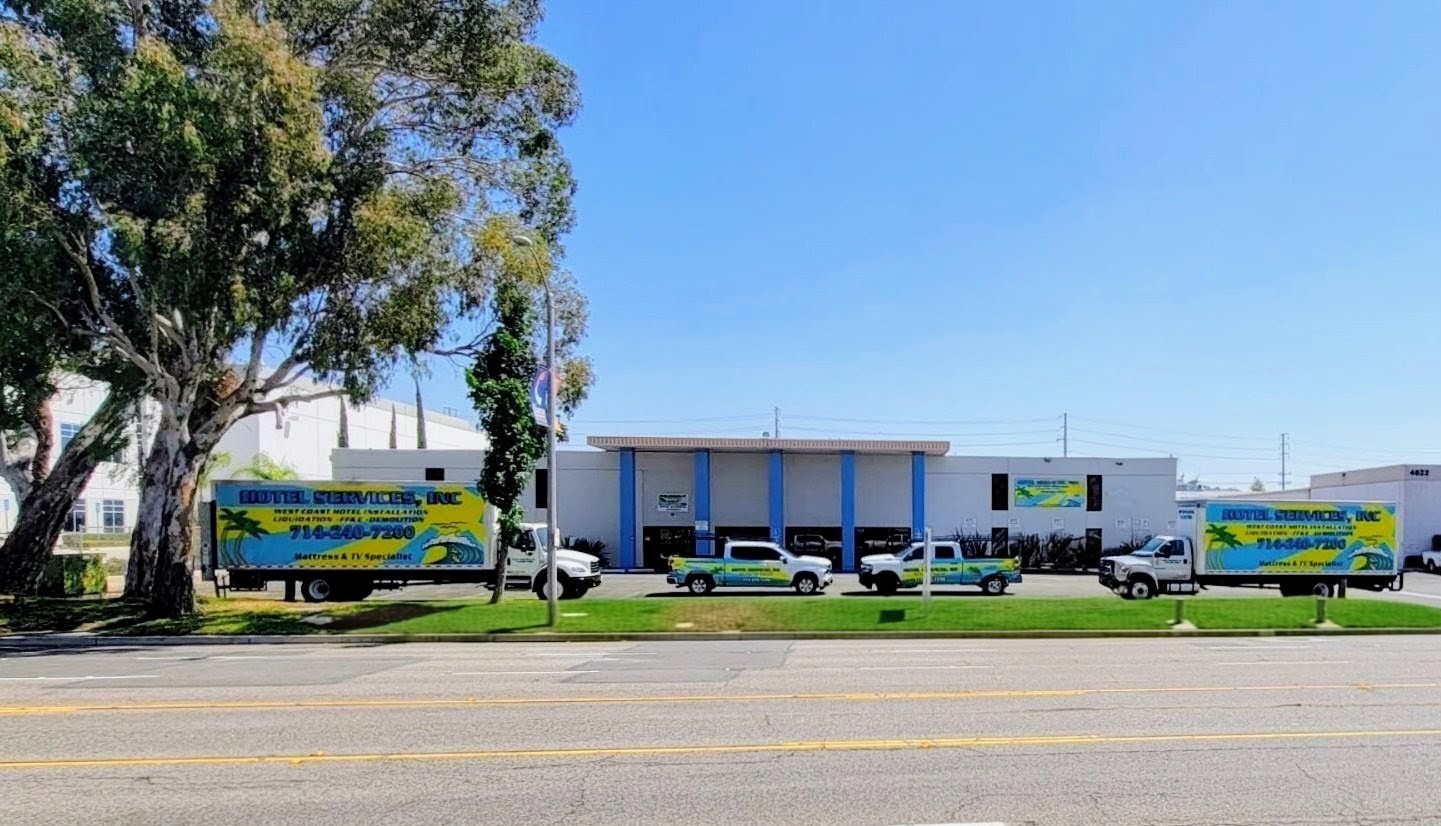
Hotel Services Inc. is located at 4640 E. La Palma Ave. in Anaheim, near the 91 and 55 freeways. That position is valuable for Southern California hotel projects because logistics are often most efficient when crews, warehouse resources, and installation capacity are concentrated in the same region. The company’s Anaheim presence also aligns with the scale of renovation activity in the local market, where multiple properties are cycling through upgrades simultaneously.
How Off-Site Staging Protects Renovation Budgets
Off-site staging eliminates several common risks. First, it prevents damage that occurs when furniture sits exposed on a construction site. Second, it allows inspection and inventory verification before items are installed, catching manufacturer defects or shipping damage early. Third, it gives project managers flexibility to adjust delivery schedules without renegotiating jobsite access or paying for on-site storage. In a market where contractor schedules shift frequently and room release dates move, that flexibility is often the difference between staying on schedule and missing a reopening deadline.
Hotel Furniture Logistics Anaheim: What Full-Service Providers Deliver
Hotel Services Inc. began in 2006 as West Coast Liquidation, later operating as West Coast Hotel Liquidation. The business has since developed into a full-service hospitality provider. Its capabilities include hotel furniture liquidation, commercial hotel furniture sales, mattress removal and installation, FF&E coordination, demolition support, recycling, and nationwide installation. This range of services allows the company to support several stages of the renovation workflow through one coordinated process.
Its liquidation crews remove unwanted furniture and decor from guest rooms and common areas, while its installation teams handle replacement furnishings according to project specifications. The company also offers mattress liquidation, mattress recycling, demolition support, and FF&E services. For owners managing renovations across multiple properties or phased upgrades within a single resort, working with a provider that can handle liquidation and installation under one contract simplifies vendor management and reduces coordination overhead.
Per-Item Pricing and Transparent Cost Structures
Most hotel furniture liquidators give owners a price based on how many hours their crew works. That approach creates uncertainty and can lead to budget overruns if the project takes longer than estimated. Hotel Services Inc. uses per-item pricing instead, so costs are tailored to the scope of the project rather than the speed of the crew. Free quotes include detailed cost breakdowns, and on-site assessments are available for regional hotels, resorts, and motels in the Southern California area. For properties located out of state, remote business solutions provide the same services and savings as local partners.
Renovation Project Coordination: Lessons from Recent Los Angeles and Anaheim Projects
Recent projects in Los Angeles and Anaheim offer practical lessons for owners planning renovations in 2026. The Hilton Anaheim’s full-property renovation, completed in October 2025, required careful phasing to keep portions of the hotel operational while guest rooms and public spaces were upgraded. The Howard Johnson Anaheim Hotel & Water Playground’s $30 million renovation, scheduled for completion in June 2027, involves similar challenges: managing contractor timelines, coordinating FF&E delivery, and minimizing disruption to guests during a multi-year project.
In Los Angeles, the scale of activity is even larger. The 1,600-room Gaylord Pacific Resort required coordination across dozens of vendors, contractors, and logistics providers to meet its 2025 opening deadline. The Tower 180 dual-branded Hyatt conversion, breaking ground in 2026, will face similar complexity as it transforms an existing structure into a 560-key hotel in the heart of downtown. These projects succeed when logistics providers can deliver furniture on a controlled schedule, install it to exact specifications, and complete punch-list items without delaying room turnover.
How Experienced Installation Crews Minimize Guest Disruption
Successful hospitality installations rely on trained, experienced crews who understand the demands of hotel environments. Their ability to handle, assemble, and install FF&E to exact specifications minimizes rework and protects renovation timelines. When crews work quickly, on a schedule, and wear uniformed shirts so they are easily identified, they stay out of the way of guests and reduce complaints. Professional teams also protect floors, walls, doors, elevators, and corridors during removal and installation, preventing damage that can delay final inspection and turnover.
Environmental Responsibility and Hotel Property Upgrades 2026
Sustainability is no longer a marketing afterthought—it is a core component of modern hotel renovations. Hotel Services Inc. partners with MBC Mattress Recycling and Gateway Mattress Recycling to give mattresses and furniture a second life, reduce landfill waste, and repurpose items for resale to independent hotels and motels. The company’s Green Certificate Program recognizes hotels that purchase repurposed furnishings as environmentally sound businesses, providing a marketing opportunity for eco-conscious properties.
From mattresses to floor lamps, from TVs to lounge chairs, the company helps properties completely remove any and all furniture while remaining environmentally friendly. This approach aligns with the growing number of travelers who prioritize sustainability when choosing accommodations, and it can differentiate properties in competitive markets like Los Angeles and Anaheim.
Conclusion: Protecting Your Renovation Timeline in 2026
Hotel renovations in Southern California are moving faster and facing more complexity than ever before. Rising tariffs, compressed timelines, and competition for contractor and logistics capacity mean that owners cannot afford to treat furniture delivery and installation as afterthoughts. The projects that succeed in 2026 will be those that build logistics into the renovation plan from the start—selecting providers with local warehouse capacity, experienced installation crews, and the ability to coordinate liquidation, staging, and installation under one contract.
Hotel Services Inc. offers a complete solution for hotel owners and general managers navigating these challenges. With a strategic location near the 91 and 55 freeways in Anaheim, per-item pricing, free quotes, and a 100% guarantee on all work, the company provides the infrastructure and expertise that protect renovation timelines and budgets. Whether you are planning a phased upgrade, a full-property transformation, or a multi-site renovation program, local logistics matter—and in 2026, they matter more than ever.
For more information or to request a free consultation, contact Hotel Services Inc. at (714) 541-7600 or visit their showroom at 4640 E. La Palma Ave. in Anaheim.