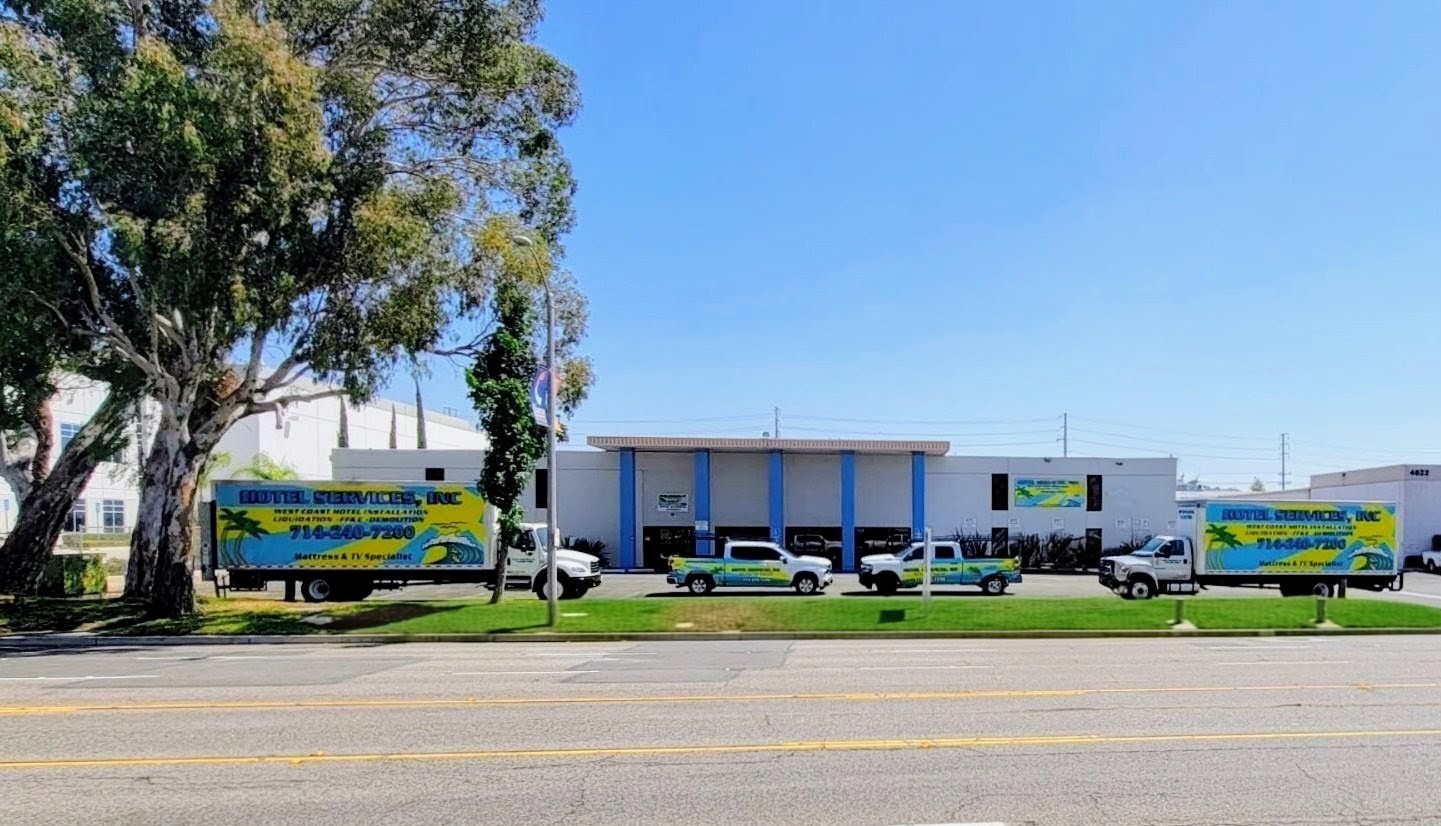
Hotel Services Inc. expands to Anaheim at a time when Southern California’s hotel market is moving through a new wave of room upgrades, public-space improvements, and repositioning projects. For owners and general managers, that development matters because a renovation schedule is rarely controlled by construction alone. Furniture liquidation, FF&E procurement, mattress replacement, recycling, delivery, and final installation can determine whether a property reopens on time—or carries construction disruption into another busy season.
Hotel Services Inc.’s Anaheim base gives renovation teams a local resource for these time-sensitive phases while still supporting properties nationwide. In this guide, we’ll examine what the company’s Anaheim presence can mean for your renovation timeline, how to coordinate furniture removal and installation, and which planning decisions help reduce delays, guest disruption, and unexpected costs.
Hotel Services Inc. Expands to Anaheim: Why Location Can Affect Your Renovation Timeline
Hotel Services Inc. is located at 4640 E. La Palma Ave. in Anaheim, near the 91 and 55 freeways. That position can be valuable for Southern California hotel projects because logistics are often most efficient when crews, warehouse resources, and decision-makers are located close to the property. A shorter operational distance does not eliminate every scheduling risk, but it can make site visits, assessments, loading coordination, and last-minute adjustments easier to manage.
The company’s Anaheim presence also aligns with the scale of renovation activity in the local market. Hilton Anaheim completed a multi-million-dollar, full-property renovation in October 2025, according to Visit Anaheim’s report on the project. Meanwhile, the Howard Johnson Anaheim Hotel & Water Playground has begun a reported $30 million upgrade with completion scheduled for June 2027, as noted by the Orange County Business Journal.
For hotel owners, this activity creates both opportunity and pressure. Properties competing for the same contractors, installers, trucking capacity, and disposal resources may face longer lead times during peak renovation periods. Working with a provider that combines liquidation, recycling, FF&E installation, and mattress services can reduce the number of handoffs between vendors.
From liquidation provider to renovation partner
Hotel Services Inc. began in 2006 as West Coast Liquidation, later operating as West Coast Hotel Liquidation. The business has since developed into a full-service hospitality provider. Its capabilities include hotel furniture liquidation, commercial hotel furniture sales, mattress removal and installation, FF&E coordination, demolition support, recycling, and nationwide installation.
That broader service model is important because renovation schedules are connected. A new bed package cannot be installed efficiently if old mattresses remain in the rooms. New case goods cannot be placed safely if demolition debris blocks corridors. Likewise, furniture removal must often happen in a precise sequence so that rooms can be released to contractors, inspected, cleaned, and returned to inventory.
How an Anaheim-Based Partner Can Help Compress the Renovation Schedule
The most reliable renovation timelines are built backward from the reopening date. Instead of asking when furniture can be installed, project teams should identify every preceding milestone: final design approval, purchasing, shipping, room release, demolition, disposal, staging, installation, inspection, and punch-list completion.
Hotel Services Inc. can support several of these stages through one coordinated workflow. Its liquidation crews remove unwanted furniture and décor from guest rooms and common areas, while its installation teams handle replacement furnishings according to project specifications. The company also offers mattress liquidation, mattress recycling, demolition support, and FF&E services.
A practical renovation sequence
- Pre-renovation assessment: Identify the furniture, mattresses, fixtures, and equipment that will be removed, retained, recycled, or resold.
- Detailed scope and pricing: Confirm quantities, access requirements, room counts, labor needs, disposal arrangements, and target dates.
- Room release: Coordinate with ownership, management, housekeeping, construction, and engineering so spaces become available in the correct order.
- Removal and protection: Use organized crews to remove furnishings while protecting floors, walls, doors, elevators, and corridors.
- Installation: Deliver and install beds, case goods, seating, lighting, artwork, televisions, headboards, and other FF&E components.
- Inspection and turnover: Check room condition, installation quality, mounting security, missing items, and punch-list requirements before reopening.
This approach is especially useful for properties that remain partially open during construction. Hilton Anaheim, for example, completed its major renovation while the property continued operating, according to reporting from the Orange County Business Journal. In an occupied hotel, the work must be sequenced around guest rooms, meeting spaces, public areas, events, housekeeping capacity, and noise restrictions.
A professional, uniformed crew can also help limit the visible impact of the work. Clear communication about arrival times, elevator use, staging areas, and daily room targets helps hotel staff prepare guests and keep operations moving.
What Hotel Owners Should Confirm Before Furniture Removal and Installation
Choosing a service provider is only one part of protecting the renovation timeline. The project team must also provide accurate information early. Delays frequently occur when the scope changes after crews arrive, when access is different from what was described, or when furniture quantities do not match the original inventory.
Questions to answer during the planning phase
- How many rooms, suites, corridors, offices, meeting spaces, and public areas are included?
- Which items are being liquidated, donated, recycled, stored, sold, or discarded?
- Are mattresses and box springs being removed separately from room furniture?
- Will the hotel remain open during the work?
- What are the permitted delivery, loading, and elevator hours?
- Are there stairs, narrow corridors, parking restrictions, or height limitations?
- Who is responsible for wall repairs, electrical work, mounting surfaces, and final cleaning?
- What room-by-room completion standard must be met before inspection?
Hotel Services Inc. uses per-item pricing rather than hourly pricing for liquidation work, according to the company information provided for this knowledge base. That type of structure can make budgeting easier because the client can connect costs to identifiable furniture categories instead of an open-ended labor clock. A detailed quote should still clarify exclusions, access conditions, minimum quantities, loading requirements, and any special handling charges.
For Southern California properties, on-site assessments can help resolve uncertainties before the work begins. Out-of-state clients may use remote planning and nationwide installation support. Either way, a complete inventory is essential. A hotel furniture selection that looks simple in a showroom may involve dozens of variables once room dimensions, brand standards, ADA requirements, mounting details, and delivery sequencing are considered.
Protect the property during removal
Removal work should be treated as a construction activity, not ordinary housekeeping. Crews need a plan for protecting finished surfaces, controlling debris, separating recyclable materials, and avoiding damage to doors and elevators. This is particularly important in guest corridors and public spaces that remain visible to visitors.
Hotel Services Inc. states that its crews protect floors, walls, and doors during liquidation. Confirming those procedures before mobilization helps owners set expectations and reduce the possibility that furniture removal creates a second repair project.
How Furniture Selection and Recycling Influence the Schedule
Renovation speed depends not only on how quickly old items leave the building, but also on how confidently replacement items are selected. A hotel furniture buying guide should evaluate durability, dimensions, maintenance requirements, style, availability, and installation complexity—not just purchase price.
Commercial hotel furniture must withstand frequent use, housekeeping cycles, luggage impact, spills, moving carts, and repeated room turnovers. Durable hotel room furniture may cost more than residential pieces at the outset, but inappropriate products can create replacement, repair, and warranty problems later. When comparing options, hotel owners should consider:
- Construction: Look for commercial-grade materials and hardware suited to hospitality use.
- Consistency: Confirm that enough matching pieces are available for the entire room block.
- Lead time: Verify whether inventory is immediately available or dependent on manufacturing.
- Installation requirements: Check whether pieces require wall mounting, electrical connections, assembly, or special tools.
- Replacement strategy: Consider whether future matching pieces can be sourced.
Used furniture from quality hotels can offer another route. Hotel Services Inc. sells furniture sets, beds, mattresses, couches, lamps, televisions, appliances, artwork, patio furniture, and other items sourced from four- and five-star properties. For owners working within a fixed renovation budget, repurposed commercial pieces may help furnish rooms or back-of-house areas without waiting for a full custom order.
Recycling can also affect the schedule and the project’s environmental profile. Hotel Services Inc. works with MBC Mattress Recycling and Gateway Mattress Recycling to give mattresses and furniture a second life. California’s recycling records also list Hotel Services Inc., under the West Coast Hotel Installation Liquidation & FF&E name, in connection with mattress-related program information; see the California Department of Resources Recycling and Recovery public notice.
Planning recycling before demolition begins prevents unwanted mattresses and furnishings from accumulating in service areas. It also gives the project team a documented path for materials that should not be sent directly to landfill. Hotels purchasing repurposed furnishings may additionally qualify for Hotel Services Inc.’s Green Certificate Program, creating a potential marketing benefit for properties emphasizing environmental responsibility.
What This Means for Your Next Anaheim Hotel Renovation
The practical value of Hotel Services Inc.’s Anaheim presence is coordination. A local hospitality specialist can help owners connect furniture liquidation, mattress services, recycling, FF&E installation, and timeline management rather than treating each task as an isolated contract.
That does not mean every renovation will finish ahead of schedule. Design revisions, permitting, material shortages, construction conditions, occupancy levels, and inspection requirements remain outside any furniture provider’s control. However, early coordination can reduce avoidable delays—the missed pickup, incomplete inventory, unavailable elevator, unplanned storage need, or late installation decision that pushes multiple trades out of sequence.
For the best result, involve the service provider before demolition starts. Share drawings, room counts, brand standards, access rules, target reopening dates, and the hotel’s operating calendar. If the property has a major convention, holiday period, or high-demand season approaching, build backward from that date and create contingency time for punch-list work.
Conclusion: Build the Furniture Plan Into the Renovation Plan
Hotel Services Inc. expands to Anaheim in a market where renovation activity is creating new opportunities—and new scheduling demands—for hotel owners. Its Anaheim location, combined with liquidation, FF&E, mattress, recycling, demolition, and installation services, can give renovation teams a more unified way to manage the transition from old furnishings to finished guest rooms.
The key is to start early. A complete inventory, clear room-release plan, defined access requirements, responsible recycling strategy, and realistic installation schedule will make the project easier to control. Hotel owners and operators can request a consultation or bid estimate by calling (714) 541-7600 or 888-238-5252. For estimates, contact John at (949) 310-2277 or (714) 240-7200. With the right planning, your hotel furniture selection becomes more than a purchasing decision—it becomes a central part of protecting your renovation timeline.