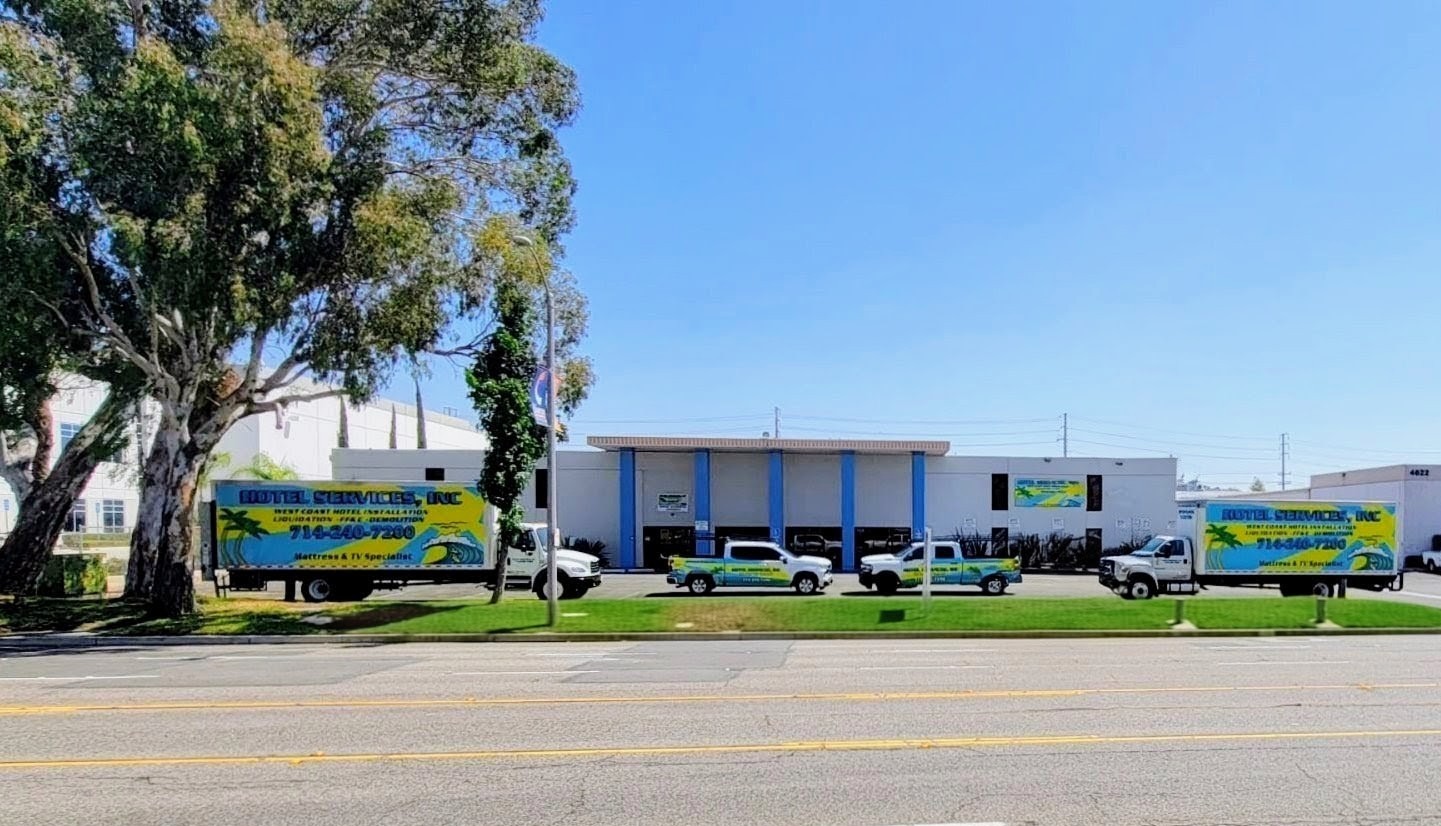
Southern California’s hotel renovation wave is accelerating in October 2026, and that momentum is creating a practical challenge for owners, general contractors, and property managers: keeping furniture, mattresses, fixtures, crews, deliveries, and guest operations moving at the same time. Across Anaheim, Dana Point, Costa Mesa, Newport Beach, and other regional markets, hotels are refreshing rooms, repositioning resort amenities, and preparing for stronger demand. The result is a renovation environment where local logistics are no longer a convenience—they are a competitive advantage.
Projects such as the $30 million Howard Johnson Anaheim upgrade, the transformation of Laguna Cliffs Marriott Resort & Spa into The Ocean Cliffs at Dana Point, and upcoming Costa Mesa room renovations demonstrate how much work is happening across Orange County. This guide explains why October 2026 is an important planning window, how local coordination reduces delays, and how Hotel Services Inc. supports hotel renovation Southern California 2026 projects with liquidation, FF&E installation, mattress services, recycling, demolition, and professional crews.
Why Southern California’s Hotel Renovation Wave Requires Local Logistics
The current wave is not limited to cosmetic improvements. Hotels are combining guest-room renovations with new public spaces, upgraded amenities, repositioning strategies, and brand transitions. That creates a complex sequence of work: old furniture must leave before new furnishings arrive, mattresses may need to be recycled or replaced, and installation teams must coordinate around contractors, housekeeping, engineering, and occupied guest areas.
In Anaheim, the Howard Johnson by Wyndham Anaheim Hotel and Water Playground began a $30 million renovation in July 2026. According to the Orange County Business Journal report on the Howard Johnson Anaheim upgrade, the project covers all 302 rooms and suites, public spaces, and amenities, with completion scheduled for June 2027. The property is remaining open during construction, making logistics and guest-disruption control especially important.
That operating model is increasingly common. Hotels want to renovate without surrendering every available room night. Instead, they phase work by building, floor, room type, or public area. A local service provider can respond faster when a room block becomes available, a delivery window changes, or a contractor needs furniture removed before the next trade begins.
Why proximity matters in Orange County
Orange County hotel projects are spread across distinct operating environments. An Anaheim resort near Disneyland and the Convention Center faces different traffic patterns and guest expectations than a coastal resort in Dana Point or a business-oriented property near John Wayne Airport. Loading access, parking limitations, resort-area congestion, event calendars, and building layouts all affect the schedule.
For that reason, hotel logistics Orange County planning should begin with a property-specific assessment. The right plan identifies loading zones, staging areas, elevator access, protected pathways, disposal requirements, room sequencing, and the best delivery times. It also accounts for what happens when the schedule changes—which it almost always does during an active renovation.
What Is Driving the 2026 Renovation Pipeline?
Several market forces are encouraging owners to reinvest in existing properties. Visit California’s September 2026 lodging forecast reported that statewide average daily rate is expected to reach $200 in 2026, a new all-time high. The forecast also noted that demand is expected to outpace supply growth, supported by strong leisure travel, convention activity, and major events. Read the Visit California and Tourism Economics 2026 lodging forecast for the broader market outlook.
When demand and rates strengthen, owners have more incentive to improve the guest experience, protect brand standards, and compete for meetings, weddings, family vacations, and extended stays. Renovation can also help older properties reposition themselves without waiting for an entirely new hotel development.
Named projects show the breadth of the wave
The regional pipeline includes both major renovations and new hospitality inventory. The Travel Costa Mesa annual report identifies a full renovation of The Westin South Coast Plaza beginning in late 2026 and continuing into 2027. It also lists a full room renovation at Residence Inn Costa Mesa Newport Beach, scheduled from mid-April through December 2026, with one building taken down at a time and eight rooms per building.
That phased approach is a useful example for hotel operators. It reduces the number of out-of-service rooms at any one time, but it increases the number of handoffs. Furniture must be removed in carefully defined batches. Replacement items must arrive in the correct sequence. Installation teams need accurate room counts, floor plans, and completion targets. A small mistake can force crews to revisit a building, extend downtime, or store inventory in a space that was not designed for it.
Coastal properties are also investing in destination-level repositioning. In September 2026, JW Marriott announced plans to transform Laguna Cliffs Marriott Resort & Spa into The Ocean Cliffs at Dana Point, a JW Marriott Resort. The project includes refreshed guest rooms, expanded event spaces, a new 6,000-square-foot ballroom, a redesigned arrival experience, a new resort pool, and a signature restaurant. The JW Marriott announcement about The Ocean Cliffs transformation describes a phased refurbishment designed to keep the property connected to its coastal identity while expanding its appeal to leisure and group guests.
Why FF&E Coordination Can Make or Break the Schedule
Furniture, fixtures, and equipment are often treated as the final layer of a renovation. In reality, FF&E affects nearly every stage of the project. Case goods may need to be removed before flooring or wall finishes can be completed. Beds and mattresses must arrive after rooms are cleaned but before inspection. TVs, artwork, headboards, lamps, seating, and appliances may each require different handling and installation requirements.
Effective FF&E coordination Anaheim projects therefore depends on more than moving items from one location to another. It requires a sequence that fits the construction schedule and respects hotel operations.
A practical furniture removal installation timeline
- Pre-project assessment: Document furniture quantities, room types, access conditions, disposal needs, and the client’s target completion dates.
- Removal planning: Establish building-by-building or floor-by-floor removal zones, including protection for floors, walls, doors, elevators, and public areas.
- Liquidation and recycling decisions: Separate items for resale, donation, recycling, storage, or disposal before crews arrive.
- Construction handoff: Confirm when rooms are ready for new case goods, beds, mattresses, lighting, artwork, and other equipment.
- Installation and inspection: Deliver and install furnishings to specification, then verify room condition, placement, hardware, mounting, and damage prevention.
- Punch-list response: Resolve missing, damaged, or incorrectly placed items quickly so rooms can return to inventory.
Without this level of coordination, a hotel can experience avoidable storage costs, incomplete rooms, duplicated labor, and delayed openings. With it, the owner receives a clearer path from demolition to guest-ready inventory.
Hotel Services Inc. supports this process through complete FF&E planning, contractor coordination, case goods movement, full-room outfitting, quality inspections, and timeline management. Its installation teams can also securely mount flat-screen televisions, wall art, and headboards, helping reduce accidental damage and theft after the renovation is complete.
How Local Hotel Logistics Reduce Guest Disruption
Many Southern California hotels are renovating while remaining open. That means the work must be organized around guests, housekeeping routes, event schedules, noise restrictions, fire and life-safety requirements, and the hotel’s daily operating rhythm. A crew that arrives without a detailed access plan can create bottlenecks in elevators, loading areas, corridors, or front-of-house spaces.
Professional logistics are especially important at large resorts. The Howard Johnson Anaheim project, for example, includes 302 rooms and a seven-acre property that remains open throughout construction. The Orange County Business Journal reported that the work includes new bridges and walkways, courtyard reconstruction, landscaping, and room reconfiguration. Such a project requires more than a one-day furniture pickup; it requires recurring coordination across multiple areas of the property.
Local knowledge supports better staging and routing
A local provider understands the difference between a property that can accept a semi-truck at a rear dock and one that requires smaller vehicles, timed arrivals, or multiple transfer runs. Local crews can also adjust more quickly when a road closure, convention, special event, or construction change affects the delivery plan.
That flexibility matters throughout Anaheim and the surrounding resort corridor. OCVIBE, the 100-acre mixed-use development surrounding Honda Center, announced in June 2026 that its first phase—including the 50,000-square-foot Katella Commons market hall—was expected to open in early 2027. The official OCVIBE hospitality and culinary announcement illustrates the region’s expanding destination infrastructure and the potential for continued pressure on local access, traffic, and hospitality demand.
Hotel Services Inc. minimizes disruption with professional uniformed crews, careful protection of the property, organized installation methods, and scheduling built around the client’s operating needs. Mattress installations are often completed in a single day, while larger furniture projects can be phased to match room releases and contractor milestones.
Why Sustainable Liquidation Belongs in Renovation Planning
Renovation creates a large volume of usable material. Beds, nightstands, sofas, chairs, lamps, artwork, patio furniture, televisions, appliances, mattresses, and box springs may no longer fit the renovated design, but that does not mean they belong in a landfill.
Hotel Services Inc. provides a systematic liquidation process for guest rooms and common areas. Items can be evaluated for resale, repurposing, recycling, or responsible disposal. The company works with MBC Mattress Recycling and Gateway Mattress Recycling to help give mattresses and furnishings a second life while reducing landfill waste.
This approach can benefit both the project budget and the property’s environmental goals. Per-item pricing provides a clearer cost structure than hourly removal, while resale value may offset some renovation expenses. Hotels that purchase repurposed furnishings through the company may also qualify for a Green Certificate recognizing environmentally responsible purchasing.
Sustainable removal is most effective when planned before demolition begins. A renovation team should identify salvageable items during the initial assessment, label them by destination, and schedule removal before new finishes are installed. That prevents usable furnishings from becoming damaged, misplaced, or mixed with construction debris.
Plan Southern California Hotel Renovations Before October Becomes the Bottleneck
October 2026 is a practical checkpoint for owners and contractors reviewing renovation schedules across Southern California. With active projects in Anaheim, Costa Mesa, Dana Point, and nearby markets, local installation and removal capacity should be reserved early rather than treated as a last-minute service.
Hotel Services Inc., based in Anaheim, provides nationwide hotel furnishing support with strong local coverage. Its services include furniture liquidation, FF&E coordination, mattress installation, mattress liquidation and recycling, demolition, furniture sales, and professional installation. The company has served the hospitality industry since 2006 and offers English- and Spanish-language support.
For a property assessment, free consultation, or bid estimate, contact Hotel Services Inc. at (714) 541-7600 or 888-238-5252. Bid estimates are also available through John at (949) 310-2277 or (714) 240-7200. The Anaheim showroom is located at 4640 E La Palma Ave, Anaheim, CA 92807, near the 91 and 55 freeways.
In a renovation market moving as quickly as Southern California’s, the right logistics partner helps protect the schedule, the property, the guest experience, and the investment.